好日脚Good Days

Triceratops

The toy shop at Kai Tak Airport was just before the gate. Inside the glass case the boxes were stacked one on top of another, like a building no one had finished. Five mechanical dinosaurs — red, black, pink, blue, yellow — boxed separately, sold separately. On the side of each box was a picture of what they became when you put them together: a giant.

Kids back then knew the rules. One at a time: one for your birthday, one for a perfect score on a test. After a year or two of saving, the giant could finally stand. Plenty of kids' giants were missing a leg for the rest of their lives.

My father said: all of them.

He pulled a stack of Hong Kong dollars from the inside pocket of his suit and didn't count it. My mother stood behind us, looking out at the runway, and said nothing. At the time I thought she was tired.

I wouldn't let the boxes go into the hold. They were piled on my lap all the way from Hong Kong to Shanghai, pressing down until my knees went numb, and I didn't move. As the plane came down, Shanghai was dark outside the window, only a few roads lit, as if someone had dragged a fingernail across a sheet of black cloth.

It was almost ten when we got home. My mother was unpacking on the balcony, dropping dirty clothes into the washing machine one piece at a time. My father sat on the sofa with the newspaper open and didn't turn a page for a long time. I knelt on the floor and opened all five boxes.

That night I was a god. I named the T. rex, wrote lines for the monsters, and made them fight battle after battle between the coffee table and the TV cabinet. When one side won, I cheered for it. When one side fell, I screamed for it. I was an only child, and I learned early that one person can be a whole army, as long as he has enough voices.

Then the T. rex swept its tail, and the blue triceratops tumbled off the coffee table and rolled up next to my father's slipper.

I crawled over to pick it up. The light came down from overhead, and caught on the triceratops's horn was a hair. Very long, longer than my arm, hanging from the tip of the horn all the way to the floor, faintly shining under the lamp, like fishing line.

I pinched it between my fingers, held it up to my eyes, and read it out the way you'd read a sign by the road:

"Long hair."

I had never seen my father move so fast. The newspaper was still in the air and he was already crouched in front of me, holding my wrist. His hand was hot.

"It's nothing, it's nothing. It just fell there."

He said it twice.

The washing machine stopped. My mother came in from the balcony holding a shirt she hadn't hung up yet. It was my father's. She looked at my hand, then at my father's hand, and then she screamed. It wasn't the sound of someone cursing. It was a sound I had never heard before, like something falling from very high up and never reaching the ground.

"You tell me! Who is she!"

"What does a kid know!"

Afterward I was shut in my room. The door closed; the sound didn't. I put the five dinosaurs together into the giant and stood it at the head of the bed, facing the door. I gave it a voice, louder and louder — cannon fire, lasers, explosions, every sound a mouth can make. I thought if the war on my side was loud enough, I wouldn't hear the one outside.

I didn't throw the hair away. I wound it around my index finger, round and round, until the tip turned purple and throbbed, like a ring on the wrong finger.

Just before dawn, it went quiet outside. The last thing I saw before I fell asleep was the giant still standing at the head of the bed, not moving, guarding the door for me.

When I woke up, the hair had broken at some point and fallen into the quilt, and I never found it. It left a white ring on my finger that took days to fade.

It was the most expensive toy my father ever bought me.
Violin

When I was a child, my father often took me to dinners. The round tables were big, the lazy Susan turned slowly, and whatever stopped in front of me was always a dish I couldn't name. Around the table sat his clients, his boss, and people who played the violin or the piano. My father said he was bringing me to see the world. So I sat there, seeing the world. When the grown-ups laughed, I laughed too, though I didn't know what they were laughing at. I only knew they were all very impressive, and I was only a child.

Later I grew up and went to New York to study photography. When I came back, I took family portraits at a photo studio. An assistant held up a rubber duck beside the lens and quacked to make other people's children laugh, and I pressed the shutter from behind.

That New Year's Eve, the whole family sat around a round table for the reunion dinner. Across the lazy Susan, my father asked how work was going. I said it was good, I was at a fairly high-end photography company, doing portraits. He snorted. "How much can a photo studio make?" The table went quiet for a moment, then someone topped up his glass, and the conversation moved on. That night, no one suggested taking a family photo.

My father still often treated those musicians to dinner, and I still sat at that round table. At first, I thought it did me credit. Later I understood: they talked to me because my father was always paying, always raising his glass, bending at the waist at exactly the right angle. Where the money came from, I never asked.

Days at the studio were slow, like a nursing home. Between shutter clicks, I read one book after another. Later I left and opened my own studio, with money my mother put up. The name on the door changed to mine, but the people who came through it were still clients who wanted to look a little better.

One day my wife dragged me to a very quiet art space. I picked up a magazine at random: Foam, issue 42, "Back to the Future." The people in it made pictures with the oldest methods, about the newest problems. The English in the essays was hard. I looked it up on my phone, word by word, and as I did, I remembered New York: classmates in seminar talking about concepts, and me in the back row with a single word in my head. Frauds.

I started submitting. After each submission came a wait of seven or eight months, and the rejection always arrived in the morning. Half a year later, someone else's work went up on the wall. Half a year after that, I submitted again. Four times, nearly five years. My wife never once asked when it would happen. On those mornings she just held me, patted my back, and said nothing.

While I waited, I translated those essays into Chinese and put them on Bilibili. In the end, more than a hundred thousand people listened to me describe the world behind that door.

One night in the winter of 2023, after dinner with family and a little wine, I was slightly tipsy on the way home. My phone lit up: Foam's editor-in-chief had followed me on Instagram. I stared at the name for a long time. Late that night, the notice came.

In Amsterdam, the curator gave me an entire corridor. The photographs were printed so large I had to step back several paces to take them in. A lot of people came on opening night, and I explained my work again and again until my voice was gone.

Afterward, my wife, my daughter, and my best friend, who had flown in from Poland, took me out for seafood. We talked about a lot of things and later forgot what. I only remember him bringing up, again, that night in college when I'd tried to win her and failed, and he'd stood with me on the dorm balcony for two hours in the cold wind, in a T-shirt and shorts, with an exam the next day. Beside him, my wife rolled her eyes: here we go again.

Later, the photographs went on to Frankfurt, and to Paris.

A year or two after that, my father arranged another dinner. The lazy Susan was still turning, and around the table were still the people who played the violin or the piano; one of them had become my friend. The mood was good. A woman violinist put down her chopsticks, looked at me, and asked very gently, "Why didn't you learn the violin back then?"

I put down my glass and said, "I'm a contemporary artist. What I do is contemporary art."

I said it very clearly, maybe a little too forcefully.

She smiled, gave a soft snort, and turned to the person beside her. "He's still like a child. Still so rebellious."

A few people at the table laughed along. Across from me, my father raised his glass, laughing as hard as he could.

I didn't say anything more. The lazy Susan slowly came around and stopped in front of me: a dish I couldn't name.

Lam Tin

Those years in Hong Kong, my father was rarely home.

Every weekend my mother took me out. We lived in an estate called Ka Chui Yuen, off Castle Peak Road. Sometimes we took the 42C, a double-decker, and I always insisted on climbing to the upper deck and sitting at the very front. Sometimes we took the shuttle bus to the MTR and rode from Kwai Fong to Lam Tin. From the station we walked a little way, and then we were at Auntie Shen's.

Her flat was about a hundred square meters, and very warm. The man of the house was rarely there either. Our two families were alike: both mothers had come out of factories; both fathers were clever, got Hong Kong residency, and brought the family over. And then both fathers were rarely home.

Auntie Shen had a daughter named Iris, a few years older than me. In her room there was a computer, and on the computer there was a game: you drove a car for your life, with dinosaurs chasing you. I wanted to play it so badly. Every time, before going into her room, I'd stand at the door for a while to see if she was busy. If she was doing homework, I didn't go in. If she was on the phone, I didn't go in either. I stood at the door, and waited.

Once I heard her tell her mother she'd rather play with me than with Doudou.

"He listens," she said. "He knows how to wait."

My father had a lot of dinners. At those round tables, if I said one wrong thing and made my mother lose face, I got a beating when we got home. What came most easily to her hand was a clothes hanger. She was still hitting me many years later, until one day a friend of hers in New York saw the bruises on me and told her: if this were America, you'd have been locked up long ago.

Decades later, I had dinner with Iris in New York. She was treating, and I was very late. She sat there alone, waiting for me, and didn't hurry me. She had become a lawyer, liked art, and kept a cat. Boyfriends had come and gone; the cat had always been the same one.

Later we all moved back to Shanghai. Auntie Shen's husband was the first to leave; he divorced her. On my father's side, one woman followed another. The two women often talked on the phone past midnight, about each other's men, each trying to talk the other round.

Auntie Shen's family favored sons, and everything good went to her brother. He was in business, and when he was drunk he'd call our house. Sometimes when we picked up, no one spoke on the other end. Sometimes he took my mother for someone else and called her by a name we didn't know. My mother hung up on him every time.

A few more years went by, and Auntie Shen started dating online. The man was much younger than her; she went all the way to the northeast to meet him. After him there were a few old men, and one of them moved in with her. The flat had come to her in the divorce; the grocery money came from him. She didn't hide any of it. At dinner she would even talk about what happened in bed.

My mother came home and told me all about it. Her scolding was very detailed. How old the man was, where he was from, how many days he'd stayed, how much grocery money he paid a month — she remembered it all exactly.

"Even if I stay single my whole life, I wouldn't want a man that smelly and that old," she said. "Your father was bad, but I've had the high-class kind. I'm not going to wrong myself by settling for garbage. Not like her. Tramp."

"How much money does she even have? What do those men want from her?" she went on. "And that daughter of hers, too. In her forties and not married, a handbag that costs tens of thousands, and whose money is she spending? Her mother's."

"A woman has to stay above it all. Your grandmother told me that from the time I was little."

At first I didn't respond. Then one time I said, "She's not married. What's wrong with dating? You can't date once you're old?"

She looked at me. "Forget it, I'm not talking to you. Your values are all wrong."

After a while she asked, "So you'd want your own mother to be like that?"

"That's your freedom. Why would I interfere?"

"And you wouldn't worry I'd spend all my money on those men?"

"If you're happy, you have my blessing. What right do I have to interfere?"

She didn't say anything. She got up and went into her room. When she came out she was holding a red envelope, and she stuffed it into my coat pocket, where it made a bulge.

"For the little one."

I pushed it back twice, then took it.

A Round of Toasts

A little past seven in the morning. The late-autumn sun is still low, slanting in between the tall camphor trees on both sides of the road. The trees have been growing for almost twenty years; their branches nearly meet overhead, turning the whole road into a green tunnel. Light leaks through the gaps in the leaves and breaks into bright patches on the asphalt, which sway a little whenever the wind blows. The bottoms of the trunks are painted white, one tree after another down the line, like a row of people standing very straight. I take the dog out. The moment we're through the door he pulls the leash taut, nose to the ground, and stops under every tree and every squarely trimmed holly hedge to sniff for a long time, as if this road he has walked hundreds of times grows something new every morning.

We walk slowly along the forest loop. A speed-limit sign at the corner says twenty. In the distance a few maples have already turned red, and the ginkgoes are a shining yellow, like color someone dabbed on carelessly among all the shades of green. On one side of the road is the water that winds through the whole estate, very still, reflecting the sky and the reeds along the bank; now and then an egret lifts a foot from the shallows and, in no hurry, moves to stand somewhere else. On the other side, house after house, beige walls and terracotta roofs. Quilts airing in some yards, a row of flowers in full bloom on some balconies, curtains still drawn in some windows, the people inside probably still asleep. The estate is so quiet you can hear someone far off sweeping leaves with a bamboo broom. The ads back then said this place brought together status, prestige and glory. But on a morning like this, all I feel is the warmth on my back and the smell of grass and wet earth. Life is so good it hardly seems real.

This house is one of the many houses my father-in-law has bought. All his life, whenever he made money, he bought houses.

The dog stops again. I stand and wait for him, and I think of something my wife once told me.

When she was little, her father worked in Jiangyin, and every so often her mother took her and her younger sister to visit him. One evening he had a banquet, and he brought the three of them along. The private room was large, the round table full, half the dishes already served, and he still hadn't arrived.

He was half an hour late. He came in smiling the whole time, bowing as he said sorry, sorry, got held up on the way.

The man in the seat of honor smiled too, very generously. "You're here, that's what matters, that's what matters." He picked up the decanter and filled a glass with baijiu. "You're late, so start with a round for the table. Just a gesture."

Everyone at the table laughed along. Some clapped. Some said, of course, of course.

He didn't sit down, and didn't eat a single bite. Holding his glass, he started from the seat of honor and toasted his way around, one person at a time. With each one he said something nice; the other person nodded and took a small sip, and he tipped his head back and drained his glass. A waitress followed behind him and refilled it the moment it was empty.

My wife sat beside her mother and watched her father make a full circle of that table. Everyone was laughing, as if this were something very happy.

After the last glass, he said, "I'll just step out to the restroom."

He walked very steadily. Once the door closed, the table grew lively again. The man in the seat of honor picked up a bite with his chopsticks and said, this fish is good, everyone try it.

That night, he threw up in the restroom.

I stand at the side of the road for a long time, the leash hanging slack in my hand. At some point the egret has flown off the water. Looking back from a distance, I can see the third-floor curtains of our house half open. He's probably awake by now, sitting on the edge of the bed, slowly feeling around for his slippers.

In the end the dog can't wait any longer and pulls me home.

I push open the door. Inside it's warm, the smells of fried eggs, toast and hot milk mixing together and drifting from the kitchen all the way to the entryway. My wife stands at the stove with her back to me, the spatula tapping lightly against the pan, her hair tied back any old way, her apron strings knotted crookedly behind her waist. The table is already set with bowls and chopsticks, the lid of the jam jar unscrewed, a plate of cut fruit beside it.

My daughter runs in barefoot from the living room, holding up a drawing to show me. On it there's a little dog with a brown head, a few fish, Mommy, me, Grandpa and Grandma, everyone holding hands, standing in a row.

"Is it pretty?"

"It's pretty."

I tuck the drawing under the jam jar and sit down to breakfast.

From the stairs comes the sound of slippers, one step at a time, slowly. My father-in-law comes down with his phone playing the show he listens to every morning. Peng Wen-cheng's voice is very loud: first he reads a passage from the Bible, then he goes back to Tsai Ing-wen's doctoral thesis — he's been on it for years, and he's still at it, getting more and more worked up, like a man chasing someone who owes him money. My father-in-law sets the phone on the table without turning it down, pulls out a chair, sits, and says to my daughter, "Come, show Grandpa what you drew."

Wind

At ten in the morning, the teacher called to say our daughter's eye had been scratched in art class.

My wife and I stood up at almost the same moment. As the car pulled out, I kept cursing the teachers — how could they not watch the children. Beside me, my wife cursed me, said I was being irrational, said we didn't even know what had happened yet. We cursed like that all the way to the school. When we got there, she was sitting on a chair in the nurse's office, one eye a little red. When she saw us she paused, as if she didn't understand why we were in such a hurry.

Shanghai hospitals are fast. Registration, waiting, the slit lamp, a young doctor saying it was nothing, a scratched cornea, a few days of eye drops and she'd be fine. Less than an hour from start to finish. When we walked out with the medicine, the sun was beautiful, so beautiful it was almost unreasonable. A lunch that was supposed to be eaten in the school cafeteria had just been handed back to us.

We found a place nearby to eat. It was a tech park: tall buildings, very bright glass, a plaza so big it seemed meant for something else, not for people.

After lunch, she started running across the plaza.

She ran far, then came back with a twig. She ran out again and came back with two small pinkish-purple flowers, the kind that grow everywhere at the edge of the grass. Then stones. She laid these things out on a bench. The bench was painted in several colors, orange-red, off-white, grayish pink, not very carefully, as though someone had stopped halfway and gone home for the day.

She put the flowers on a stone, looked at them for a while, then took another stone and weighed the flowers down with it.

"Now the wind can't blow them away," she said.

On the next bench sat a few people who had just finished lunch, ID badges still hanging on their chests. They smoked and chatted. One said that back home it would already be snowing. Another said at least winter where he was from was dry; Shanghai cold goes right into your bones. A third laughed and said it was damp where he was from too, but damp in a different way. What exactly was different, he thought about for a while and couldn't say.

The smoke slowly drifted off, all in the same direction.

"Daddy, why do the flowers keep blowing away?"

I looked down. The stone was still there; one of the flowers under it was gone. She went to the grass and picked another, put it back, and pressed down a little harder.

After a while she asked again, "Why do they keep blowing away?"

I said, because flowers are too light.

She wasn't satisfied with that answer. She thought the stone was already very heavy.

My wife sat beside me, squinting at her. I watched the smokers stub out their cigarettes, stand up, brush off their trousers, and walk back toward that glass building.

Where were their children?

The plaza was empty again. Only the three of us, and a great deal of sunlight.

She was still fighting the wind. The flowers blew away one by one, and she replaced them one by one, until she couldn't keep up. Then she crouched beside the bench, chin resting on the back of her hand, watching the last one tremble under the stone.

"It wants to leave," she said.

I didn't answer. The wind kept blowing in the same direction.

Suzhou Creek

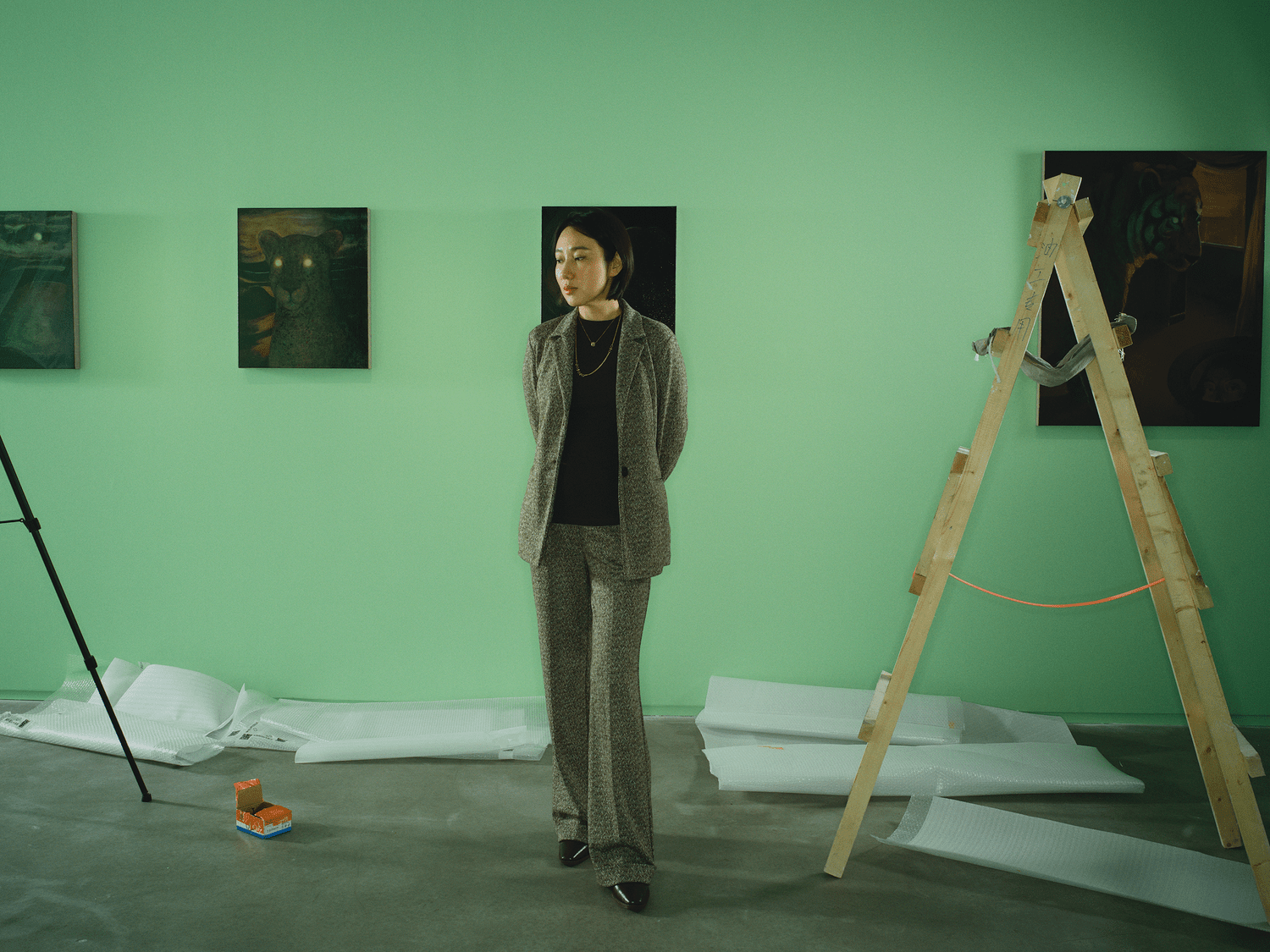
By the time I finished photographing Song Ke, it was almost one o'clock. The gallery's next show opened in a week — a painter of animals. Half the paintings were up; a few more leaned against the wall on the floor, wrapped in bubble wrap. She stood in front of a painting that hadn't been hung straight yet and let me photograph her. I carried three lights in, then carried them out again one by one. The back of my sweatshirt was soaked through.

I stuffed the gear into the trunk and went next door for coffee.

First I asked the guy behind the counter where the restroom was. He was wiping cups and didn't look up. Upstairs, he said.

I came back down and ordered an Americano. He looked up, asked if I wanted to switch to oat milk, said today's beans had a slightly floral note. His voice had gone much softer.

I carried my coffee to the river and leaned on the railing in the sun.

The water of Suzhou Creek was yellow and thick. The sun shone down on it but couldn't get in; it only broke into pieces of light on the surface. On the far bank stood a row of old warehouses. Ninety-some years ago they held things for banks; now they'd been turned into a creative park, and one of them was a Swedish photography museum. The brick walls were old, the windows many, and not one of them was open. Behind them rose a new tower, tall and pointed.

The sun was really good, warm on my back, warm enough to make you go soft.

Two young people walked past me. Their accents weren't from Shanghai.

"This river is so pretty."

"Oh, it's so nice. How is it this nice?"

"Those buildings over there, so chic."

They stood by the railing for a while and took a photo together, the yellow river behind them.

All along the river, people were taking pictures.

An old man had a camera hanging on his chest. He wore a photographer's vest and a hat; his hair was white, and he gave off a heavy smell of cigarettes that the wind carried a long way. He was photographing a woman in her thirties. She wore a black shawl, her lips painted very red, her face turned in profile toward the river.

"My profile isn't good," she said.

"Don't you worry," the old man said, in Shanghainese. "On Xiaohongshu, I've shot plenty of women."

He took out his phone, opened it, and held his hand out to show her. He didn't look at the screen himself. He turned his face the other way, eyes half closed, as if those photos had been in his heart for a long time.

She glanced at it. "That's not right for me. I want it like this."

They argued a little, then laughed and went on shooting. A few aunties stood nearby holding their bags, watching very closely. Now and then one of them would say, very nice.

Further along, a girl in a white sweater and knit hat leaned against the low wall by the river, arms spread wide, waiting for her friend to take her picture. A middle-aged man with a backpack came over, a bald patch on the top of his head shining in the sun. He didn't know her, and he didn't hide. He just stood beside her friend, raised his phone, and took one picture after another. Her friend glanced at him, said nothing, and kept shooting.

A girl in a camel coat crouched by the railing, looking down at her phone, waiting for someone. A guy with bleached-blond hair walked up — leather jacket, a Canon hanging on his chest — and asked if she wanted a street portrait, said he could make her look really good. She didn't look up, just waved him off. He stood there a while, then moved off to the side, leaned on the railing, and looked across at the row of old buildings.

The person she was waiting for never came.

I stood by the river a long time. My back was burning in the sun.

Two girls walked past me. One of them wore a tight beige sweater with a low neckline. She walked fast, the sweater stretched full, surging up with every step, as if about to spill over the neckline. My eyes followed her for several steps before I pulled them back.

Then I raised my phone and took a picture of the old man photographing the woman in the black shawl: him bent over, squinting; her in profile, lips very red. I posted it to a group chat, one we mostly use for talking about people behind their backs. I typed three letters: OMG.

Someone replied with three exclamation marks.

No one knew.

I finished the coffee. I walked back to the shop and dropped the cup in the trash can by the door. The guy was wiping the counter. He didn't look up.

I drove home, the light stands in the trunk rattling softly the whole way.

The texts are not about the people in the photographs.

Good Days